Back

Nernst Equation definitions

Control buttons has been changed to "navigation" mode.
1/15
  • Nernst Equation

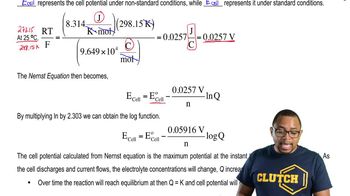
    Mathematical relationship linking cell potential to concentrations, temperature, and number of electrons transferred under nonstandard conditions.
  • Cell Potential

    Electrical potential difference between two electrodes, reflecting the driving force for electron flow in an electrochemical cell.
  • Standard Conditions

    Reference state with 1 M concentration, 25°C temperature, pH 7, and 1 atmosphere pressure for comparing cell potentials.
  • Standard Cell Potential

    Maximum voltage of an electrochemical cell when all reactants and products are at standard conditions.
  • Gas Constant

    Physical constant (8.314 J/mol·K) relating energy scale to temperature and amount of substance in thermodynamic equations.
  • Faraday's Constant

    Quantity of electric charge per mole of electrons, approximately 9.649 × 10⁴ coulombs per mole.
  • Reaction Quotient

    Ratio of product and reactant activities at any point, indicating the cell's position relative to equilibrium.
  • Equilibrium Constant

    Value of the reaction quotient when the system is at equilibrium, reflecting the extent of a reaction.
  • Gibbs Free Energy

    Thermodynamic quantity indicating the maximum reversible work obtainable from a chemical reaction at constant temperature and pressure.
  • Activity

    Effective concentration of a species in solution, accounting for non-ideal behavior via an activity coefficient.
  • Number of Electrons Transferred

    Integer representing how many electrons move between reactants in a redox reaction, affecting cell potential calculations.
  • Natural Logarithm

    Logarithmic function with base e, used in the Nernst equation to relate concentrations to cell potential.
  • Common Logarithm

    Logarithmic function with base 10, used for simplified calculations in the Nernst equation.
  • Dead Battery

    State where cell potential drops to zero as the electrochemical cell reaches equilibrium and can no longer produce current.
  • Redox Reaction

    Chemical process involving the transfer of electrons between species, fundamental to electrochemical cell operation.