How do you calculate the percent transmittance of a sample in UV-Vis spectroscopy if its absorbance is 0.419?
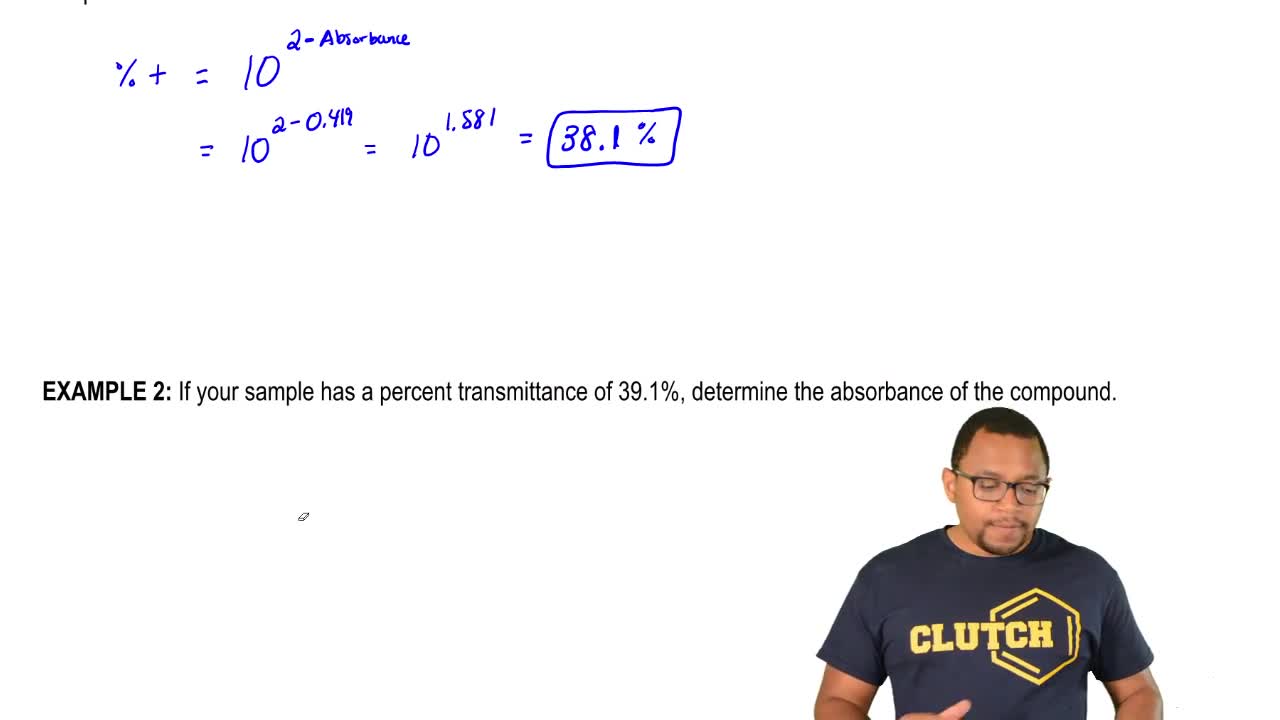
Percent transmittance (%T) is calculated using the formula %T = 10^(-A) × 100, where A is absorbance. For an absorbance of 0.419, %T = 10^(-0.419) × 100 = 38.1%.
If a sample in UV-Vis spectroscopy has a percent transmittance of 39.1%, how do you determine its absorbance?
Absorbance (A) can be calculated from percent transmittance (%T) using the formula A = -log10(%T/100). For %T = 39.1%, A = -log10(0.391) = 0.407.
What does absorbance represent in UV-Vis spectroscopy?
Absorbance represents the quantity of light that a sample absorbs.
How is percent transmittance (%T) defined in UV-Vis spectroscopy?
Percent transmittance is the amount of light that passes through a sample.
What is the mathematical relationship between absorbance (A) and percent transmittance (%T)?
Percent transmittance is calculated as %T = 10^(-A) × 100.
If a sample has an absorbance of 0.419, what is its percent transmittance?
The percent transmittance is 38.1%.
How do you calculate absorbance if you know the percent transmittance?
Absorbance is calculated using the formula A = -log10(%T/100).
What is the absorbance of a sample with a percent transmittance of 39.1%?
The absorbance is 0.407.
How are absorbance and percent transmittance related to each other?
They are inversely related; as absorbance increases, percent transmittance decreases.
What happens to light absorption and transmittance as the concentration of a sample increases?
As concentration increases, the sample absorbs more light and less light is transmitted through it.
What does the absorbance value displayed on a spectrophotometer represent?
The absorbance value represents the quantity of light that a sample absorbs in UV-Vis spectroscopy.
What is a calibration curve in the context of measuring absorbance?
A calibration curve is a plot of absorbance versus concentration for a series of standard solutions, used to determine the concentration of unknown samples.
What is the purpose of a calibration curve in analytical chemistry?
The purpose of a calibration curve is to establish the relationship between absorbance and concentration, allowing for the determination of unknown sample concentrations based on their absorbance.
In what units is absorbance measured in UV-Vis spectroscopy?
Absorbance is a unitless quantity; it has no units.
What are the transmission and absorbance values of a blank sample in spectrophotometry?
A blank sample ideally has 100% transmittance and an absorbance of 0.
What is the unit for absorbance in a spectrophotometer?
Absorbance is unitless; it does not have any units.
What units are absorbance measured in?
Absorbance is measured without units; it is a dimensionless quantity.
How are percent transmittance and absorbance related algebraically in UV-Vis spectroscopy?
Percent transmittance (T) and absorbance (A) are related by the formula: T = 10^(-A) × 100%.
How do you calculate percent transmittance from a given absorbance value?
Percent transmittance is calculated using the formula: percent transmittance = 10^(-absorbance) × 100%.
How can you find percent transmittance from absorbance in spectrophotometry?
Percent transmittance can be found using the formula: percent transmittance = 10^(-absorbance) × 100%.
How do you find transmittance from absorbance in UV-Vis spectroscopy?
Transmittance (as a decimal) is calculated as T = 10^(-A), where A is absorbance.
How do fingerprints on a cuvette affect absorbance measurements in spectrophotometry?
Fingerprints on a cuvette can increase absorbance readings by blocking or scattering light, leading to inaccurate results.
What are the units of absorbance in spectrophotometry?
Absorbance is a dimensionless quantity and has no units.
 Back
Back
 02:24
02:24