Skip to main content
Analytical Chemistry
My Course
Learn
Exam Prep
AI Tutor
Study Guides
Flashcards
Explore
Try the app
My Course
Learn
Exam Prep
AI Tutor
Study Guides
Flashcards
Explore
Try the app
Back
Ka and Kb of compounds quiz
You can tap to flip the card.
What does the equilibrium constant Ka represent?
You can tap to flip the card.
👆
What does the equilibrium constant Ka represent?
Ka represents the acid dissociation constant for a weak acid and measures the strength of weak acids.
Track progress
Control buttons has been changed to "navigation" mode.
1/15
Related flashcards
Related practice
Recommended videos
Ka and Kb of compounds definitions
Ka and Kb of compounds
15 Terms
Ka and Kb of compounds
8. Monoprotic Acid-Base Equilibria
5 problems
Topic
Weak Acid-Base Equilibria
8. Monoprotic Acid-Base Equilibria
5 problems
Topic
8. Monoprotic Acid-Base Equilibria - Part 1 of 2
4 topics
12 problems
Chapter
8. Monoprotic Acid-Base Equilibria - Part 2 of 2
4 topics
12 problems
Chapter
Guided course
04:05
Ka and Kb
2
views
Guided course
01:21
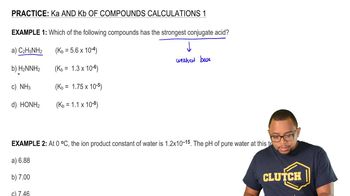
Ka and Kb Calculations 1
3
views
Guided course
03:32
Ka and Kb
2
views
1
rank
Terms in this set (15)
Hide definitions
What does the equilibrium constant Ka represent?
Ka represents the acid dissociation constant for a weak acid and measures the strength of weak acids.
What does the equilibrium constant Kb represent?
Kb represents the base dissociation constant for a weak base and measures the strength of weak bases.
How are Ka and acid strength related?
A higher Ka value indicates a stronger acid, which produces more H+ ions in solution.
What is the typical value range for Ka and Kb of weak acids and bases?
Both Ka and Kb for weak acids and bases are less than 1.
What does a Ka or Kb value less than 1 indicate about product formation?
It indicates that very little product is formed and the reaction establishes an equilibrium.
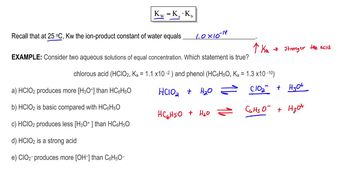
What is the relationship between Ka, Kb, and Kw?
Ka and Kb are related by the equation Kw = Ka × Kb, where Kw is the ion product constant for water.
What is the value of Kw at 25°C?
At 25°C, Kw equals 1.0 × 10⁻¹⁴.
How can you find Kb if you know Ka for a conjugate acid-base pair?
You can find Kb by dividing Kw by Ka: Kb = Kw / Ka.
What is ignored in the equilibrium expression for Ka and Kb?
Solids and liquids, such as water, are ignored in the equilibrium expression.
What is the general form of the equilibrium expression for Ka?
Ka = [A⁻][H₃O⁺] / [HA], where water is not included in the expression.
What is the general form of the equilibrium expression for Kb?
Kb = [BH⁺][OH⁻] / [B], ignoring water in the expression.
According to the Bronsted-Lowry theory, what does a weak acid do in water?
A weak acid donates an H⁺ to water, forming A⁻ and H₃O⁺.
According to the Bronsted-Lowry theory, what does a weak base do in water?
A weak base accepts an H⁺ from water, forming BH⁺ and OH⁻.
How are pKa and Ka related?
A higher Ka corresponds to a lower pKa, indicating a stronger acid.
Why do weak acids and bases establish equilibrium in solution?
Because they only partially ionize, resulting in both reactants and products being present at equilibrium.
 BackBack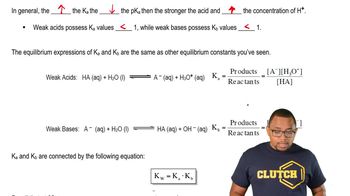
 04:05
04:05