What is the isoelectric point (pI) of a polyprotic acid?
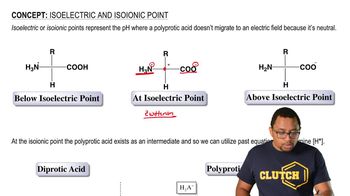
The isoelectric point is the pH at which a polyprotic acid is neutral and does not migrate in an electric field, existing as a zwitterion.
How do amino acids behave in acidic solutions relative to their isoelectric point?
Below the isoelectric point, amino acids act as cations because their carboxyl group is protonated, resulting in a net positive charge.
What happens to an amino acid in a basic solution above its isoelectric point?
Above the isoelectric point, the amino acid acts as an anion because the ammonium group is deprotonated, resulting in a net negative charge.
What is a zwitterion in the context of amino acids?
A zwitterion is a form of an amino acid with both a negatively charged carboxyl group and a positively charged ammonium group, making it overall neutral.
How many pKa values do most amino acids have and why?
Most amino acids have two pKa values due to their carboxyl and amino groups, each capable of being protonated or deprotonated.
What is the formula for calculating the isoelectric point (pI) of a diprotic acid?
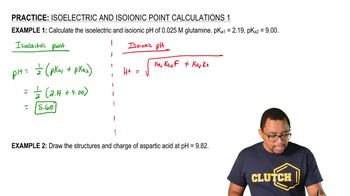
The isoelectric point for a diprotic acid is calculated as pI = ½(pKa1 + pKa2).
How is the isoionic point related to the intermediate form of a polyprotic acid?
At the isoionic point, the polyprotic acid exists as an intermediate form, and its H+ concentration can be calculated using specific equations.
What is the equation for H+ concentration at the isoionic point for a diprotic acid?
The H+ concentration equals the square root of (Ka1 × Ka2 × formal concentration) plus (Ka1 × Kw) divided by (Ka1 + formal concentration).
How many intermediate forms does a triprotic acid have?
A triprotic acid has two intermediate forms, each associated with different pH values and equations.
Which pKa values are used to calculate the isoelectric point for acidic amino acids?
For acidic amino acids, the two lower pKa values are used to calculate the isoelectric point.
Name two acidic amino acids and their abbreviations.
Aspartic acid (ASP, D) and glutamic acid (GLU, E) are acidic amino acids.
Which pKa values are used to calculate the isoelectric point for basic amino acids?
For basic amino acids, the two higher pKa values are used to calculate the isoelectric point.
Name three basic amino acids and their abbreviations.
Arginine (ARG, R), histidine (HIS, H), and lysine (LYS, K) are basic amino acids.
What is the relationship between the isoelectric point and the average charge of an acid?
At the isoelectric point, the average charge of the acid is zero because the acid form equals the conjugate base form.
Why do cations and anions migrate in an electric field, but zwitterions do not?
Cations and anions have net charges and are attracted to opposite plates in an electric field, while zwitterions are neutral and do not migrate.
 Back
Back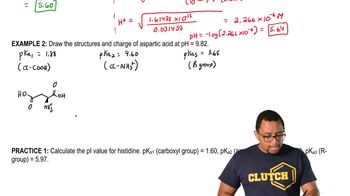
 03:34
03:34