What happens to silver bromide when it is placed in water?
Silver bromide dissociates into its ions, establishing an equilibrium with very little ion production due to its low solubility.
What does the solubility product constant (Ksp) indicate about ionic solids?
Ksp values for ionic solids are typically much less than 1, indicating minimal solubility in a solvent.
What is the common ion effect?
The common ion effect occurs when a solution contains an ion shared with the dissolving ionic solid, decreasing its solubility.
How does adding sodium bromide affect the solubility of silver bromide?
Adding sodium bromide introduces a common bromide ion, which decreases the solubility of silver bromide.
What principle explains the decrease in solubility when a common ion is added?
Le Chatelier's principle explains that adding a product ion shifts the equilibrium toward the solid, reducing solubility.
What happens to the solubility of silver bromide when silver acetate is added?
Silver acetate provides a common silver ion, which also decreases the solubility of silver bromide.
How does the common ion effect influence the direction of equilibrium?
The common ion effect shifts the equilibrium toward the solid form, favoring crystallization over dissolution.
What is the effect of adding sodium perchlorate to a silver bromide solution?
Sodium perchlorate does not share ions with silver bromide, so it increases the solubility by raising ionic strength.
Why does adding non-common ions increase the solubility of an ionic solid?
Non-common ions increase ionic strength, causing the equilibrium to shift forward and produce more ions.
What is ionic strength and how is it represented?
Ionic strength is a measure of all ions in an aqueous solution and is represented by the symbol μ.
How is ionic strength calculated?
Ionic strength is calculated as half the sum of the concentrations of the ions times the square of their charges.
What effect do non-common ions have on free floating ions in solution?
Non-common ions surround free floating ions, prompting the ionic solid to dissolve more to maintain equilibrium.
What is the relationship between ionic strength and solubility?
Increasing ionic strength generally increases the solubility of an ionic compound.
What happens to the equilibrium when ionic strength is increased by non-common ions?
The equilibrium shifts forward, resulting in more dissolution of the ionic solid and more ions in solution.
What is the main difference between the common ion effect and ionic strength effect?
The common ion effect decreases solubility by shifting equilibrium toward the solid, while increased ionic strength from non-common ions increases solubility.
 Back
Back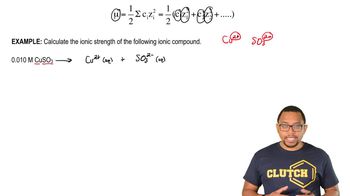
 02:24
02:24