What does it mean for a strong acid or base to be a strong electrolyte?
It means they completely ionize in solution, resulting in 100% generation of H+ or OH- ions.
How is the strength of an acid indicated?
The strength of an acid is indicated by its Ka value; a Ka greater than 1 means the acid is strong.
What does a Kb value greater than 1 indicate about a base?
A Kb value greater than 1 indicates the base is strong and produces a high concentration of OH- ions.
What happens to hydrochloric acid when it is dissolved in water?
It completely ionizes into H+ and Cl- ions, with 100% ionization.
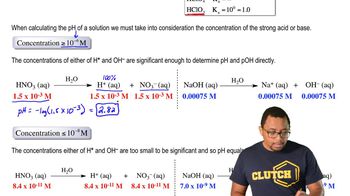
How do you calculate pH for a strong acid with concentration ≥ 10^-6 M?
You take the negative logarithm of the acid's concentration to find the pH.
How do you calculate pOH for a strong base with concentration ≥ 10^-6 M?
You take the negative logarithm of the base's concentration to find the pOH.
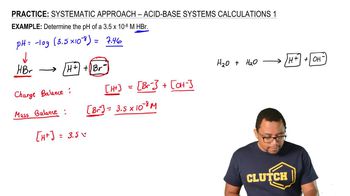
What is the pH of a solution when the strong acid or base concentration is less than 10^-8 M?
The pH is 7, because the concentration is not significant enough to alter the pH from neutral.
Why must the autoionization of water be considered for concentrations between 10^-6 M and 10^-8 M?
Because water contributes additional H+ and OH- ions, affecting the overall pH or pOH.
What is the general approach to finding pH or pOH for strong acids and bases?
The method depends on the initial concentration: direct calculation for high concentrations, autoionization consideration for intermediate, and neutral pH for very low concentrations.
What is the result of 100% ionization for strong acids and bases?
The initial concentration of the acid or base equals the final concentration of the ions formed.
What is the pH of a solution with 1.5 x 10^-3 M nitric acid?
The pH is 2.82, calculated by taking the negative log of the concentration.
What is the pOH of a solution with 7.6 x 10^-4 M sodium hydroxide?
The pOH is 3.12, calculated by taking the negative log of the concentration.
What happens to pH calculation when the concentration of acid or base is less than 10^-8 M?
The acid or base is not sufficient to change the pH, so the solution remains neutral at pH 7.
What must be considered when the concentration of strong acid or base is between 10^-6 M and 10^-8 M?
The autoionization of water must be considered, as it affects the total ion concentration.
Why is it important to know the initial concentration of a strong acid or base before calculating pH or pOH?
Because the calculation method changes depending on whether the concentration is high, intermediate, or low.
 Back
Back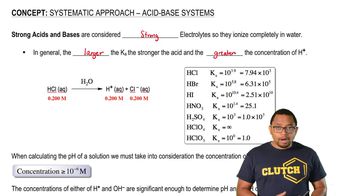
 02:03
02:03