Skip to main content
Analytical Chemistry
My Course
Learn
Exam Prep
AI Tutor
Study Guides
Flashcards
Explore
Try the app
My Course
Learn
Exam Prep
AI Tutor
Study Guides
Flashcards
Explore
Try the app
Back
Dependence of Solubility on pH quiz
You can tap to flip the card.
What equation relates the activity coefficient (gamma) and ionic strength (mu) when the ion size parameter is known?
You can tap to flip the card.
👆
What equation relates the activity coefficient (gamma) and ionic strength (mu) when the ion size parameter is known?
The extended Debye-Hückel equation relates the activity coefficient and ionic strength when the ion size parameter (alpha) is known.
Track progress
Control buttons has been changed to "navigation" mode.
1/15
Related flashcards
Related practice
Recommended videos
Dependence of Solubility on pH definitions
Dependence of Solubility on pH
15 Terms
Dependence of Solubility on pH
12. Advanced Topics in Equilibrium
5 problems
Topic
Fractional Compositions and Concentrations
12. Advanced Topics in Equilibrium
5 problems
Topic
12. Advanced Topics in Equilibrium
3 topics
9 problems
Chapter
Guided course
02:58
Ionic Salts & Solubility
1
views
Guided course
02:09
Ionic Salts & Solubility Calculations 1
1
views
Guided course
03:00
Ionic Salts & Solubility
2
views
Terms in this set (15)
Hide definitions
What equation relates the activity coefficient (gamma) and ionic strength (mu) when the ion size parameter is known?
The extended Debye-Hückel equation relates the activity coefficient and ionic strength when the ion size parameter (alpha) is known.
When is the Davies equation used instead of the extended Debye-Hückel equation?
The Davies equation is used when the size parameter (alpha) is unknown, especially for monovalent ions.
For which types of ions is the Davies equation most accurate?
The Davies equation is most accurate for monovalent ions, such as sodium or chloride.
How does the activity coefficient change as ionic strength increases?
As ionic strength increases, the activity coefficient decreases.
Do ions with the same magnitude of charge but opposite signs have the same activity coefficient according to the Davies equation?
Yes, ions with the same magnitude of charge, regardless of sign, have the same activity coefficient according to the Davies equation.
What is the minimum charge required for a transition metal cation to be considered acidic?
A transition metal cation must have a charge of +2 or higher to be considered acidic.
What is the minimum charge required for a main group metal cation to be considered acidic?
A main group metal cation must have a charge of +3 or higher to be considered acidic.
How does increasing pH affect the solubility of acidic salts?
Increasing pH (making the solution more basic) increases the solubility of acidic salts.
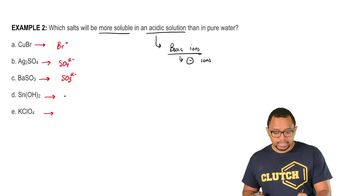
What happens to the solubility of a basic anion when the pH is decreased?
Decreasing the pH (making the solution more acidic) increases the solubility of a basic anion.
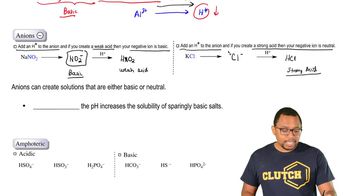
How can you determine if an anion is basic or neutral?
If adding H+ to the anion forms a weak acid, the anion is basic; if it forms a strong acid, the anion is neutral.
What is the effect of adding OH- to a solution containing an acidic cation?
Adding OH- decreases the H+ concentration, shifting equilibrium to produce more ions and increasing the solubility of the acidic cation.
What is the effect of adding H+ to a solution containing a basic anion?
Adding H+ neutralizes OH-, shifting equilibrium to produce more ions and increasing the solubility of the basic anion.
How do amphoteric species behave in terms of solubility and pH?
Acidic amphoteric species become more soluble at higher pH, while basic amphoteric species become more soluble at lower pH.
What is the relationship between the solubility of acidic salts and the pH of the solution?
The solubility of acidic salts increases as the pH of the solution increases (becomes more basic).
What is the relationship between the solubility of basic salts and the pH of the solution?
The solubility of basic salts increases as the pH of the solution decreases (becomes more acidic).
 BackBack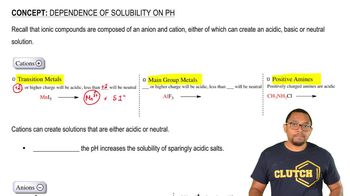
 02:58
02:58